
Discover the ECHOLOT foundation and its main pillars
ECHOLOT aims to deliver innovative, user-friendly, accessible technical solutions and collaboration models that interconnect and enrich cultural heritage datasets. Developed by a consortium with strong ties to major EU infrastructure projects, including the European Open Science Cloud (EOSC), ECHOES, and the Data Space for Cultural Heritage (DS4CH), ECHOLOT is well placed to provide cultural organisations with a user-friendly system that enables them to create and/or modify content once and publish it on multiple platforms while receiving enriched data in return.
However, the benefits of ECHOLOT’s approach will not be limited to these major stakeholders. ECHOLOT also aims to facilitate data enrichment and reuse on a large scale by enabling the interconnection of authority data generated by national institutions and aggregators and specialised data produced by smaller organisations and citizen-led initiatives. At the core of ECHOLOT’s offering is the powerful synergy between the Europeana network of aggregation and its vast dataset, combined with Wikimedia‘s highly collaborative, bottom-up citizen science tools.
Furthermore, as a contribution to the development of ECCCH and its adoption by Cultural Heritage professionals and researchers (CHPR), ECHOLOT will enable the creation, provision, and reuse of high-quality, semantically rich, and interoperable Cultural Heritage (CH) data, making it accessible to scholars and institutions of any size and significantly lowering the threshold for joining the collaborative cloud.
To ensure these goals are achieved, the activities and objectives of ECHOLOT are based on four key pillars. These pillars lie at the very heart of the ECHOLOT foundation.
Integration and Interoperability
The first pillar involves developing a software suite that will be seamlessly integrated into the ECCCH infrastructure as a service. ECHOLOT will provide an end-to-end solution for the collaborative curation, enrichment, management, publication and dissemination of cultural heritage data. This new service will rely on knowledge graphs (KGs) as the key technology for applying the FAIR data principles to heterogeneous datasets. It will also contribute to the ‘FAIR-ification’ of cultural heritage data by integrating with other relevant systems, including: Europeana, DS4CH and EOSC, as well as Wikidata and other knowledge platforms in the Wikimedia ecosystem.
Workflows and Enrichment
The second pillar centres on developing hybrid curation workflows that efficiently combine automated processing and human input. The latest advancements in semi-automated entity recognition and linking, summarisation, description generation, image and multimedia annotation, and multilingual alignment will be customised and made available to ECHOLOT’s target communities via user-friendly interfaces. Crucially, the service will support mechanisms for the detailed capture and embedding of metadata about individual human and software agent contributions, ensuring correct attribution and management of value and ownership in collaborative data generation processes.
Innovation and Sustainability
The third pillar focuses on developing innovative collaboration and business models in close partnership with CHPRs and ECHOLOT case study stakeholders. The new module for capturing and attributing intellectual property and other associated rights will transform cultural heritage institutions data input and encourage cooperation, sharing, and reuse. Using best practices in open-source software development will facilitate the long-term maintenance of the service. A comprehensive sustainability plan will be co-developed with the relevant stakeholders.
Collaboration and Communities
Any solution requires not only easy-to-use tools, but also a compelling case for incorporating them into established workflows. To inform the development of the ECHOLOT system and validate its usability and take-up, the fourth pillar consists of engaging with diverse cultural heritage institutions across Europe through a series of five case studies. The case studies will deliver enriched metadata to aggregation platforms such as Europeana and Wikidata, and will experiment with ’roundtripping’ feeding the enriched data back to the data providers.
This collaboration strategy aims to bridge the gap between institutional efforts contributing to the ECCCH and Europeana, and citizen-science-led initiatives on Wikimedia projects. Training resources, interactive workshops, and other forms of engagement with target audiences will encourage wider adoption of the service and the ECCCH infrastructure as a whole.
If you want to always stay updated about our project, follow us on LinkedIn, Mastodon and Bluesky!
Share this article
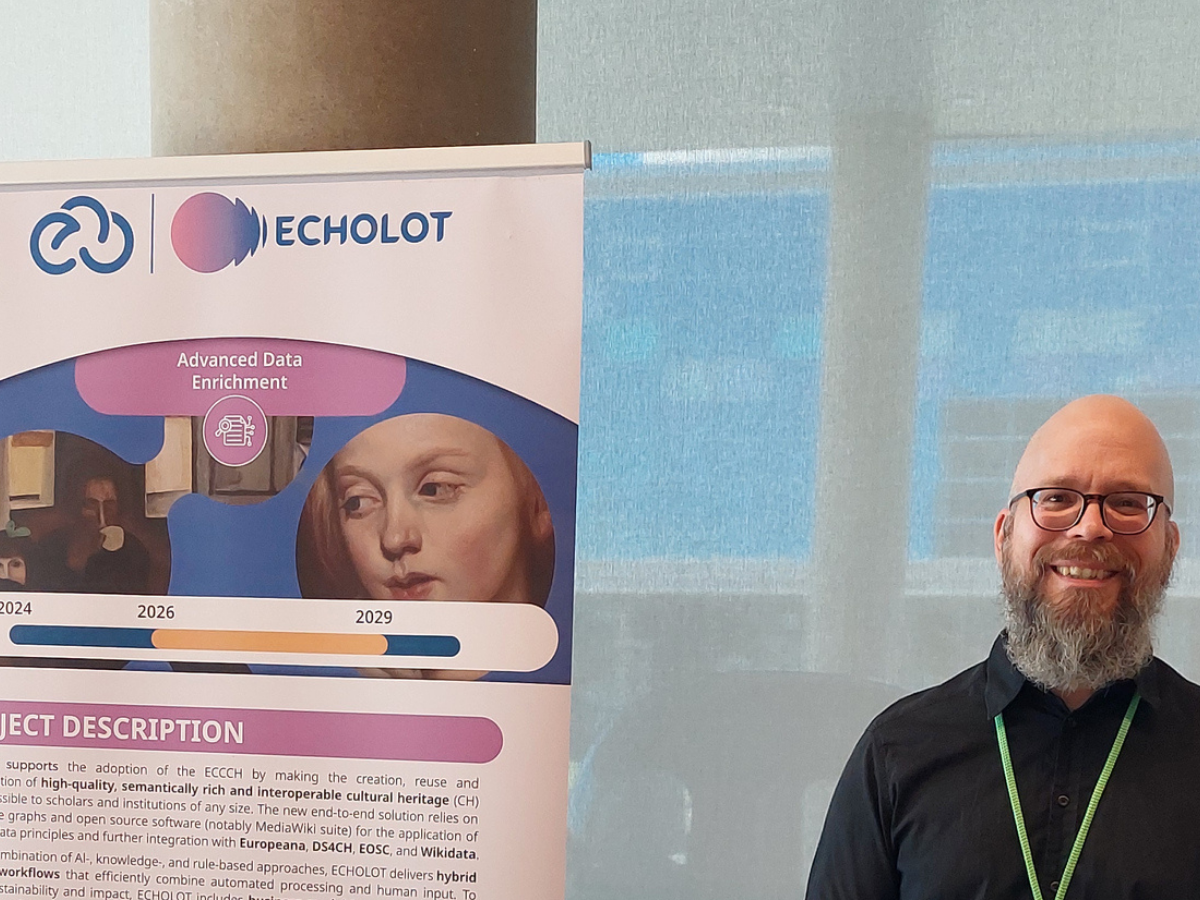
ECHOLOT at the Oulu Löyly Open culture think & do fest

From 8 to 10 June, AvoinGLAM organised the 'Oulu Löyly' event as part of the 'Oulu 2026 – European Capital of Culture' programme. Designed as an open culture think-and-do workshop, it brought…
ECHOLOT participates at the GOBLIN Hackathon
The GOBLIN Hackathon on Metadata and Provenance for Knowledge Graphs took place from 8 to 9 June in Oviedo, Spain. Organised by the GOBLIN COST Action at the School of Computer Science of the…